

Nortrane Signals Communications

//_Capability Area / Signals & Communications Technology_//

Assured Connectivity in Contested Environments

Nortrane facilitates direct commercial procurement of satellite communications, assured navigation, and deployable command technology for international defense and security clients. We connect qualified organizations with proven American manufacturers through structured, commercially efficient acquisition channels.

Assured Positioning. Resilient Communications. Global Asset Awareness.
//_Strategic Context_//

The Operational Requirement

Modern defense and security operations depend on communications and navigation infrastructure that performs without failure in environments specifically designed to defeat it. GPS jamming, satellite signal spoofing, denied spectrum conditions, and remote terrain without cellular coverage are no longer edge cases. They are operational realities that defense establishments and critical infrastructure operators plan around every day.

Nortrane's signals and communications advisory practice addresses this requirement directly. We provide strategic guidance and procurement facilitation services to defense establishments, security agencies, maritime authorities, aviation operators, and critical infrastructure organizations. Our role is that of a trusted facilitator: identifying the right technology, from the right American manufacturers, delivered through direct commercial sale channels that qualified international clients can access without government-to-government agreement requirements.

Nortrane does not manufacture communications or navigation technology. All systems available through our facilitation network are procured from established American manufacturers and technology providers. Nortrane's value is in advisory, sourcing, and procurement coordination on behalf of international clients through direct commercial sale.
//_Threat Environment_//

Why Communications Resilience Is Now a Procurement Priority

Satellite-based navigation has become the backbone of military operations, maritime commerce, aviation safety, and critical infrastructure timing. That dependency has also created a significant vulnerability. Adversaries with the ability to jam or spoof GPS and GNSS signals can, without a conventional weapon, degrade an entire operational environment.

The scale of this threat has grown substantially. GNSS jamming and spoofing incidents increased by more than 220 percent between 2021 and 2024. Maritime disruptions have become a daily operational concern across the Arabian Gulf, the Baltic, the Eastern Mediterranean, and the Black Sea. In 2025, more than 13,000 vessels were affected by documented GPS spoofing events across 27 exclusive economic zones. In March 2025, the International Civil Aviation Organization, the International Maritime Organization, and the International Telecommunication Union issued a joint warning calling for immediate action.

For defense establishments and critical infrastructure operators, the strategic implication is clear: communications and navigation systems must be designed with resilience as a primary requirement. That means moving beyond single-source GNSS dependency toward layered, alternative-source architectures that continue to function when conventional signals are compromised. This is the technology domain where Nortrane focuses its signals and communications advisory practice.

GPS Jamming & Spoofing

Low-cost jamming equipment is widely accessible. Spoofing attacks inject counterfeit signals that receivers accept as valid, corrupting navigation without alerting the operator to the compromise.

Denied Spectrum Environments

Electronic warfare operations deliberately degrade or eliminate the radio frequency environment that conventional communications depend upon. Satellite-independent architectures are the resilient alternative.

Remote Terrain & Austere Operations

Mountainous terrain, open ocean, polar regions, and contested border areas routinely fall outside cellular and terrestrial communications coverage. Satellite-based systems provide the only reliable alternative.

Critical Infrastructure Timing Risk

Power grids, telecommunications networks, and secure communications systems derive timing synchronization from GPS. A loss of GPS timing integrity has cascading systemic consequences across these infrastructures.

//_Technology Portfolio_//

Capability Areas

Nortrane's signals and communications procurement facilitation covers four primary technology categories. Each addresses a distinct operational requirement and is available through direct commercial procurement channels for qualified international clients.

Assured Positioning, Navigation and Timing

APNT technology provides positioning, navigation, and timing data that remains accurate and operationally trustworthy even when GPS and GNSS signals are jammed, spoofed, or otherwise unavailable. Where conventional GPS receivers fail, APNT systems draw on alternative positioning sources, including Iridium satellite-based PNT services, to maintain continuous and verified location and timing data.

The operational significance of timing integrity extends beyond navigation. In defense networks, microseconds of timing loss can desynchronize secure communications, degrade electronic warfare system coherence, and disrupt radar operations. APNT systems are designed to prevent these failures through redundant, independently sourced timing architectures. Solutions are available in ruggedized, field-deployable configurations for integration across land vehicle platforms, unmanned aerial systems, maritime vessels, fixed infrastructure, and aviation platforms.

Platform / Application APNT Operational Benefit
Land Vehicles & Convoys Continuous navigation and timing in GPS-jammed or contested terrain
Unmanned Aerial Systems GPS-denied navigation for border surveillance, ISR, and BVLOS operations
Maritime Vessels Anti-spoofing protection for vessel navigation in high-interference zones
Critical Infrastructure Timing resilience for power grids, telecommunications, and secure communications
Aviation Platforms Navigation continuity in areas of active electronic warfare interference
System Category Operational Application
Handheld Messenger Devices Two-way satellite messaging, GPS tracking, and emergency alert for personnel in remote environments
Vehicle & Convoy Trackers Real-time position reporting for ground vehicles operating beyond cellular coverage
Aviation Tracking Units Certified satellite tracking for manned and unmanned aviation including BVLOS UAV operations
Maritime Tracking Systems Vessel position, speed, and heading monitoring across open ocean and coastal operating areas
Asset & Cargo Monitors High-value cargo and container tracking for defense logistics and critical supply chain operations

Satellite Asset Tracking

Satellite-based asset tracking provides persistent, real-time location awareness for personnel, vehicles, vessels, aircraft, and cargo across any terrain and in any weather, without reliance on terrestrial cellular or line-of-sight communications infrastructure. Systems operating through low Earth orbit constellations provide truly global coverage, including polar regions and open ocean areas where no ground-based alternative exists.

For beyond visual line of sight UAV operations, satellite tracking and command-and-control links have become operationally critical. Satellite-connected tracking systems have achieved regulatory certification for BVLOS UAV operations, validating their reliability for command, control, and telemetry at extended ranges where no line-of-sight or cellular alternative is available. Nortrane facilitates procurement of handheld satellite messenger devices, compact vehicle-integrated trackers, aviation and UAV tracking terminals, and maritime tracking systems.

Satellite Communications Terminals

Satellite communications terminals provide voice, data, and broadband connectivity independent of terrestrial infrastructure. Military and government operators depend on SATCOM for beyond-line-of-sight command and control, intelligence data relay, operational coordination between geographically separated units, and continuity of communications when terrestrial networks are unavailable or inaccessible.

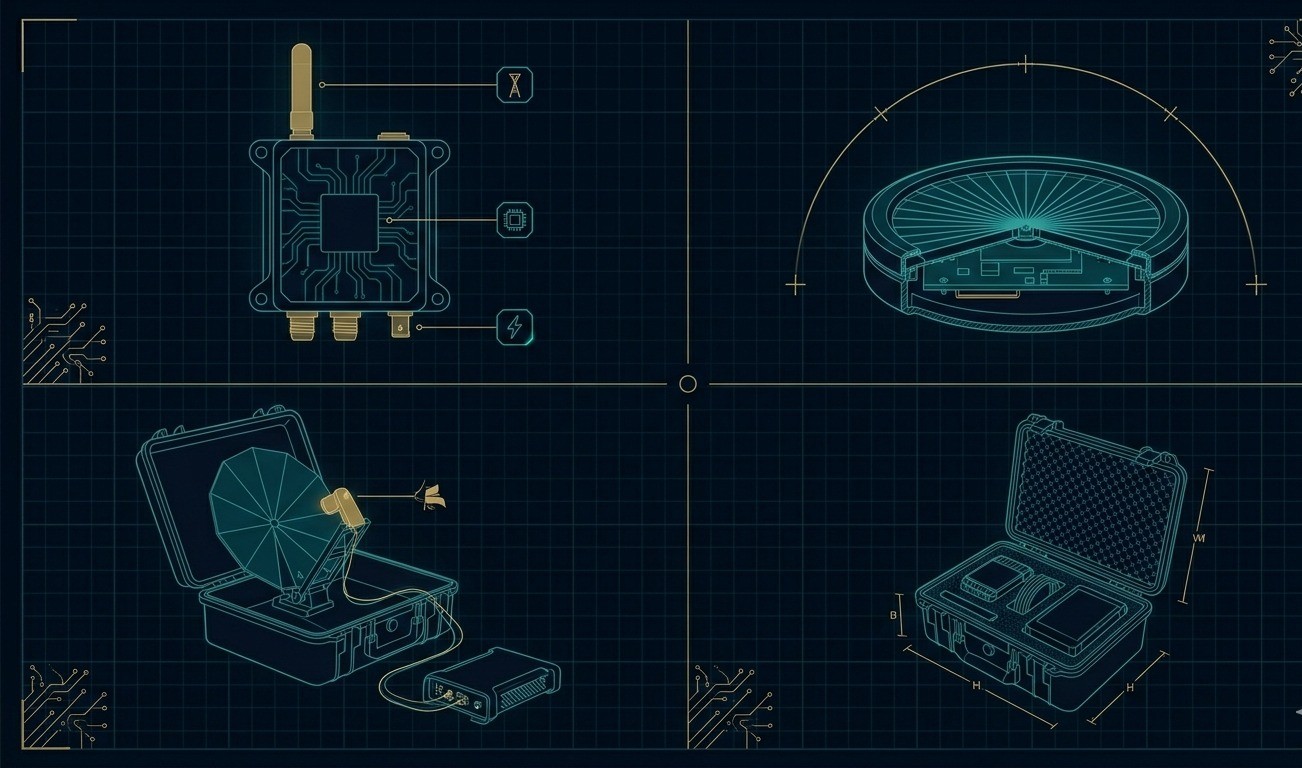
Technology available through Nortrane's facilitation network includes fixed and mobile SATCOM terminals, man-portable flyaway terminals, maritime SATCOM systems for vessel connectivity, aviation SATCOM for airborne platforms, and vehicular-mounted terminal solutions. Systems span multiple frequency bands, including L-Band, C-Band, Ku-Band, Ka-Band, and X-Band, with multiband architectures capable of accessing both military and commercial satellite constellations.

Terminal Category Operational Configuration
Fixed Ground Terminals High-bandwidth satellite connectivity for established command posts and operational headquarters
Man-Portable Flyaway Terminals Rapid deployment voice and data capability for forward-deployed or expeditionary operations
Maritime SATCOM Systems Vessel connectivity for naval, coast guard, and maritime security operations at sea
Aviation SATCOM Airborne communications for manned aircraft, UAVs, and surveillance platforms
Mobile / Vehicular Terminals On-the-move satellite connectivity for command vehicles and tactical operations centers
System Type Deployment Profile
Tactical Operations Center Kits Portable, self-contained command and control packages deployable in under 30 minutes
Rapid Deployment Communication Kits Pre-configured satellite communications bundles for emergency and expeditionary operations
Vehicular Docking Stations Integration systems converting portable satellite devices into vehicle-mounted communications nodes
External Antenna Systems Enhanced signal performance for vehicle, maritime, and fixed-site satellite deployments
Satellite Phone Systems Voice communications independent of terrestrial network availability

Deployable Command and Communications Kits

Rapid deployment communications kits and portable tactical operations center packages provide self-contained command and control capability that can be established in minutes in any location, without pre-existing infrastructure. These systems combine satellite communications, power generation, rugged computing, and physical protection in a single transportable package designed for immediate operational deployment.

Systems available through Nortrane's facilitation network include tactical box systems integrating satellite terminal, power, and field-grade computing; vehicle docking station solutions that convert portable satellite devices into vehicle-integrated communications systems; external antenna systems for improved signal quality in challenging environments; and ruggedized communications kits configured for specific operational profiles.

//_Client Base_//

Sectors and Organizations Served

Nortrane serves clients whose operational requirements place them beyond the coverage and reliability of conventional terrestrial communications and navigation infrastructure. These organizations share a common need for systems that perform in denied, degraded, or remote environments, procured through commercially structured acquisition channels.

01

Maritime & Port Authorities

Naval, coast guard, and maritime security agencies, port authorities, and commercial shipping operators requiring vessel tracking, navigation resilience against spoofing, and reliable offshore communications.

02

Aviation & UAV Operators

Defense and government aviation operators requiring satellite-based tracking and communications for manned and unmanned platforms, particularly for BVLOS surveillance and border monitoring operations.

03

Critical Infrastructure Operators

Power grid operators, telecommunications providers, offshore energy installations, and remote industrial operations with requirements for GPS timing resilience and satellite communications beyond cellular coverage.

04

Defense & Security Establishments

Ground force, naval, and air force establishments requiring assured communications and navigation resilience for operations in contested electronic warfare environments, including APNT, maritime SATCOM, and deployable command communications.

05

Disaster Management & Emergency Response

National disaster management agencies and civil defense authorities requiring rapid deployment communications for coordination when terrestrial infrastructure is damaged or overwhelmed.

06

Border & Remote Security Operations

Border security forces, frontier corps, and remote patrol units requiring persistent asset tracking, satellite communications, and navigation capability in terrain where no terrestrial infrastructure exists.

//_Procurement Model_//

How Nortrane Works in This Sector

Nortrane operates as a strategic advisor and procurement facilitator, not as a manufacturer, distributor, or reseller. Our commercial role in the signals and communications sector involves four elements: requirements scoping, supplier identification, commercial structuring, and procurement coordination. All procurement facilitated by Nortrane is structured as direct commercial sale, not foreign military sale.

01

Requirements Scoping

We work with client organizations to define their operational requirements in terms that translate accurately into technology specifications. A client may present a need in operational language. Nortrane translates these requirements into the technical parameters that guide supplier identification and system selection.

02

Supplier Identification and Sourcing

Nortrane maintains active advisory relationships with American defense technology manufacturers across the signals and communications sector. We identify suppliers and specific products best aligned with a client's validated requirements, and conduct due diligence on commercial availability, export licensing status, and delivery timelines.

03

Commercial Structuring

All procurement facilitated by Nortrane is structured as direct commercial sale. This pathway offers qualified international clients a streamlined acquisition channel that does not require U.S. government-to-government agreements. Pricing is structured on an all-inclusive basis; Nortrane's facilitation compensation is built into the commercial structure, not invoiced separately.

04

Procurement Coordination

Nortrane coordinates commercial documentation, export licensing advisory support, shipment logistics coordination, and delivery confirmation. Technical training, installation, and ongoing maintenance remain the responsibility of the manufacturer or their designated service partners.

//_Faq’s_//

Frequently Asked
Questions.

Nortrane's advisory team is available for initial consultations to assess your organization's procurement objectives, market position, and strategic priorities. Engagements are confidential, and initial consultations are complimentary for qualified organizations.
List

Still Have Questions?

Book Appointment
quick response

Work with the same creatives each time no friction.

APNT refers to positioning, navigation, and timing systems designed to operate reliably when GPS and GNSS signals are jammed, spoofed, or otherwise unavailable. Conventional GPS receivers fail in these conditions, which adversaries have learned to exploit through low-cost jamming equipment. APNT systems use alternative satellite constellations, inertial navigation, and multi-source signal fusion to maintain accurate position and timing data regardless of GPS availability. For defense operations, this matters because nearly every modern military system depends on accurate, continuous timing and positioning. Loss of GPS in a contested environment is not a communications inconvenience; it is an operational capability degradation.

GPS jamming involves broadcasting radio frequency interference that overwhelms or blocks the GPS receiver's ability to acquire satellite signals. The receiver recognizes it cannot get a fix and reports an error condition. Spoofing is more sophisticated: it transmits counterfeit GPS signals that mimic legitimate satellite transmissions, causing the receiver to calculate an incorrect position that it believes to be valid. Spoofing is more dangerous because the operator may not realize navigation data has been corrupted until a positional error becomes apparent operationally. Anti-spoofing capability, which verifies signal authenticity rather than simply acquiring a signal, is a distinct technical requirement addressed by APNT architectures.

Yes. Satellite-based tracking systems operate entirely independently of cellular and terrestrial telecommunications infrastructure. Systems operating through low Earth orbit constellations provide genuine global coverage, including open ocean, polar regions, mountainous terrain, and remote areas where no ground-based network exists. This is the primary operational advantage over GSM or cellular-dependent tracking systems, which lose coverage precisely in the environments where defense and security operations most frequently require persistent asset visibility.

A Tactical Operations Center kit is a self-contained, portable package that combines satellite communications equipment, power systems, and field-grade computing hardware in a rugged, transportable enclosure. In practice, deployment means removing the system from its transport case, extending antennas, connecting power, and establishing a satellite link, a process that modern systems accomplish in under 30 minutes with minimal specialized training. These kits provide voice, data, and situational awareness capability for forward command posts, disaster response coordination centers, maritime security operations, and any scenario requiring immediate command connectivity without dependence on fixed infrastructure.

Foreign Military Sale is a U.S. government-to-government procurement process managed by the Defense Security Cooperation Agency. It requires an intergovernmental agreement and involves U.S. government oversight of the transaction. Direct Commercial Sale is a government-authorized procurement pathway in which an international client purchases equipment directly from an American manufacturer or through a licensed intermediary, without the requirement for a bilateral government agreement. Direct commercial sale offers qualified buyers a more streamlined acquisition process with greater flexibility in configuring procurement terms. All transactions remain subject to U.S. export control regulations regardless of which pathway is used.

Export control requirements vary by technology type, end user, and destination. Satellite communications equipment, APNT systems, and associated components may be subject to the Export Administration Regulations, the International Traffic in Arms Regulations, or both, depending on their technical specifications and intended application. Some technologies require individual export licenses; others may qualify for license exceptions under specific conditions. Nortrane provides strategic advisory context on how export control frameworks apply to procurement decisions. All specific export control determinations and licensing applications must be handled by qualified export control legal counsel. Nortrane is not a law firm and does not provide legal opinions on compliance matters.

Yes. Maritime applications are one of the strongest demand areas within Nortrane's signals and communications practice. Maritime GNSS spoofing has become a genuine operational crisis, with tens of thousands of documented incidents annually spanning the Arabian Gulf, the Baltic, the Eastern Mediterranean, and other high-traffic maritime regions. Anti-spoofing APNT systems, maritime SATCOM terminals, vessel tracking systems, and portable communications kits for patrol craft and coast guard operations are all within Nortrane's facilitation scope.

No. Nortrane's role is advisory and procurement facilitation only. Technical training, installation support, and ongoing maintenance are the responsibility of the equipment manufacturer or their designated service partners. Nortrane coordinates the commercial procurement transaction and delivery logistics; the manufacturer provides product support in accordance with their standard commercial service terms. Clients should factor manufacturer support agreements into their procurement planning from the beginning of the acquisition process.

A productive initial engagement typically requires the client's organization type and country, a description of the operational requirement or capability gap they are addressing, a general sense of scale and timeline, and confirmation of end-user status for export licensing assessment purposes. Nortrane does not require a detailed technical specification at first engagement. Translating operational requirements into technical specifications is part of the advisory service we provide.

Disclaimer

The information provided on this page represents strategic advisory context only and does not constitute legal advice. Nortrane is not a law firm. Organizations should consult qualified legal counsel for advice specific to their situation.

Strategic Advisory Notice

The information provided on this page represents strategic advisory context only and does not constitute legal advice. Nortrane is not a law firm. All content discussing export control, regulatory compliance, or licensing requirements reflects general strategic context and should not be relied upon as legal guidance. Organizations should consult qualified legal counsel for advice specific to their situation, including all export control and licensing determinations.

Submitting an inquiry through Nortrane's contact channels does not create an attorney-client relationship or any formal advisory engagement. Initial consultations are informational in nature and do not constitute a binding agreement. Nortrane maintains strict institutional confidentiality standards for all client engagements.

List
//_NORTRANE_//

Begin a Procurement Advisory Engagement

Qualified international clients are invited to submit an initial inquiry. Nortrane will respond with a structured advisory consultation at no obligation.