About Us
The argument in favor of using filler text goes something like this: If you use real content in the Consulting Process, anytime you reach a review point you’ll end up reviewing and negotiating the content itself and not the design.
C-130 Hercules Fleet Support: Parts, Avionics Upgrades and the Level D Simulator Upgrade Path
C-130 Hercules Fleet Support: Parts, Avionics Upgrades and the Level D Simulator Upgrade Path
C-130 Hercules Fleet Support: Parts, Avionics Upgrades and the Level D Simulator Upgrade Path
More than 70 nations operate the C-130 Hercules. Most of the older airframes in active service today are training on Level B or Level C simulators that cannot replicate the full operational environment crews face in service. This blog covers the C-130 parts supply chain, avionics upgrade options for the H-model, and why the upgrade path to a Level D full-motion simulator is now accessible to any serious operator.
The Most Widely Operated Military Transport Aircraft in the World
The Lockheed C-130 Hercules first flew in 1954. Today, more than 70 nations operate variants of the family, from the original B-model airframes that have been in service for over six decades to the current C-130J Super Hercules still in production at Marietta, Georgia. No military transport aircraft has a broader global operational footprint. That reach also means the C-130 support, parts, and training market is one of the largest in military aviation, and it is one where the gap between what older operators have and what current capability standards require is widening every year.
For air forces operating C-130B, C-130E, or C-130H airframes acquired in the 1970s, 1980s, or 1990s, the challenge is not flying the aircraft. The platform is proven and durable. The challenge is maintaining it cost-effectively as original equipment manufacturers progressively reduce support for older variants, and training crews to the standard that modern operations demand when the training equipment available has not kept pace with operational requirements.
The Parts Supply Chain for Ageing C-130 Variants
The C-130H is powered by four Allison T56-A-15 turboprop engines. The T56 is a mature powerplant with a deep aftermarket support ecosystem, but ageing airframes bring parts challenges that go well beyond the engines. Hydraulic system components, cargo handling equipment, avionics line-replaceable units, structural inspection requirements, and propeller systems all have finite service lives and progressively harder-to-source original components as production runs end and OEM stock is depleted.
The specific categories that create the most operational disruption for C-130H operators are avionics components manufactured to 1970s and 1980s specifications with no direct modern equivalent, hydraulic actuators and control surface components that require specialist overhaul rather than simple replacement, and structural parts that require engineering disposition before use because original drawings and material specifications are no longer easily accessible from the OEM supply chain. Nortrane sources across all three categories through verified compliant supply chains that provide the traceability documentation that airworthiness requirements demand.
Avionics Upgrade: The Glass Cockpit Pathway
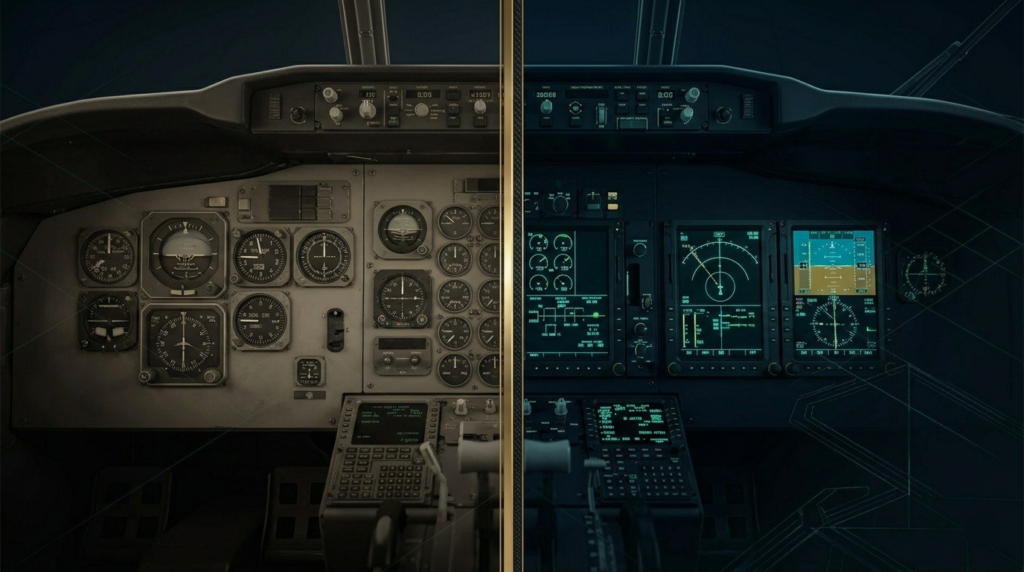
The C-130H cockpit as originally configured is an analogue environment. Electromechanical instruments, analogue navigation systems, and communications suites designed for a different operational era create significantly higher crew workload than a modern glass cockpit, particularly during instrument approaches, formation operations, and degraded visual environments. Several upgrade packages exist that bring the C-130H to a modern avionics standard without retiring the airframe.
The core elements of a C-130H glass cockpit upgrade are a modern primary flight display and multifunction display system replacing the analogue instrument panel, a digital flight management system providing GPS navigation and improved fuel management, updated communications architecture including VHF and HF digital radios, and night vision goggle-compatible lighting and head-up display integration. Each element can be procured and integrated incrementally, allowing operators to prioritise based on their most pressing capability gaps and available budget in any given planning cycle.
The Simulator Gap: Why Level B and Level C Are No Longer Sufficient
Many C-130H operators are training on Level B or Level C simulators. These devices were appropriate when procured, but they no longer replicate the full operational environment that C-130 crews face today. A Level B simulator provides a fixed-base cockpit with basic visual and instrument simulation. A Level C adds a more capable visual system and improved systems fidelity. Neither provides the six-degree-of-freedom motion platform that allows crews to experience realistic turbulence, engine failures, crosswind landings, and the physical cues a real aircraft produces during emergency procedures.
The operational consequence of training exclusively on Level B or Level C simulators is that crews develop procedures knowledge without the physical conditioning that proper emergency response requires. The global trend for C-130 operators is toward Level D full-motion certification, and the technology that underpins Level D devices has matured significantly over the past fifteen years. Modern Level D simulators are more compact, more software-driven, and more maintainable than the large hydraulic-platform devices of the previous generation.
Level D: What to Specify When Procuring
Several elements are non-negotiable in a Level D C-130 simulator specification. The simulator must be specified for the exact variant in service. A C-130H simulator configured for the T56-A-15 engine and analogue cockpit is fundamentally different from a C-130J simulator. Mixed-fleet operators must specify this precisely or risk receiving a generic device that does not accurately replicate their aircraft. Military operators require the simulator to replicate specific surface-to-air and air-to-air threat systems present in their operating environment, named specifically in the tender document. The specification must also cover loadmaster and flight engineer stations, because training the full crew in a single device is significantly more cost-effective than procuring separate partial trainers for each crew position.
How Nortrane Supports C-130 Programs
On sourcing, Nortrane helps operators procure T56 engine components, avionics line-replaceable units, hydraulic system parts, and structural components through verified, compliant channels, qualifying suppliers, confirming traceability, and coordinating the export authorization the transaction requires. On the simulator side, we provide specification development support and independent procurement advisory for operators evaluating an upgrade from Level B or Level C to Level D, helping the procurement team translate operational training requirements into a specification that vendors cannot misinterpret and conducting factory acceptance testing to verify the delivered device performs what was promised before final payment is released.
“The C-130 has been flying for over seventy years and will continue flying for decades more. The platforms that serve it well are the ones that invest properly in training devices and parts supply chains rather than deferring those investments until an operational gap forces an expensive emergency solution.”
